


The Sinopie Museum opens its doors to contemporary art with Gianni Lucchesi
A silent dialogue between images, sounds and matter. On the ground floor of the Museo delle Sinopie, in Piazza dei Miracoli, Pisan artist Gianni Lucchesi presents two works that intertwine different languages in a single vision. These are the video installation ‘People’ and the marble sculpture ‘Operae’, both of which can be viewed free of charge in an area separate from the traditional museum itinerary.
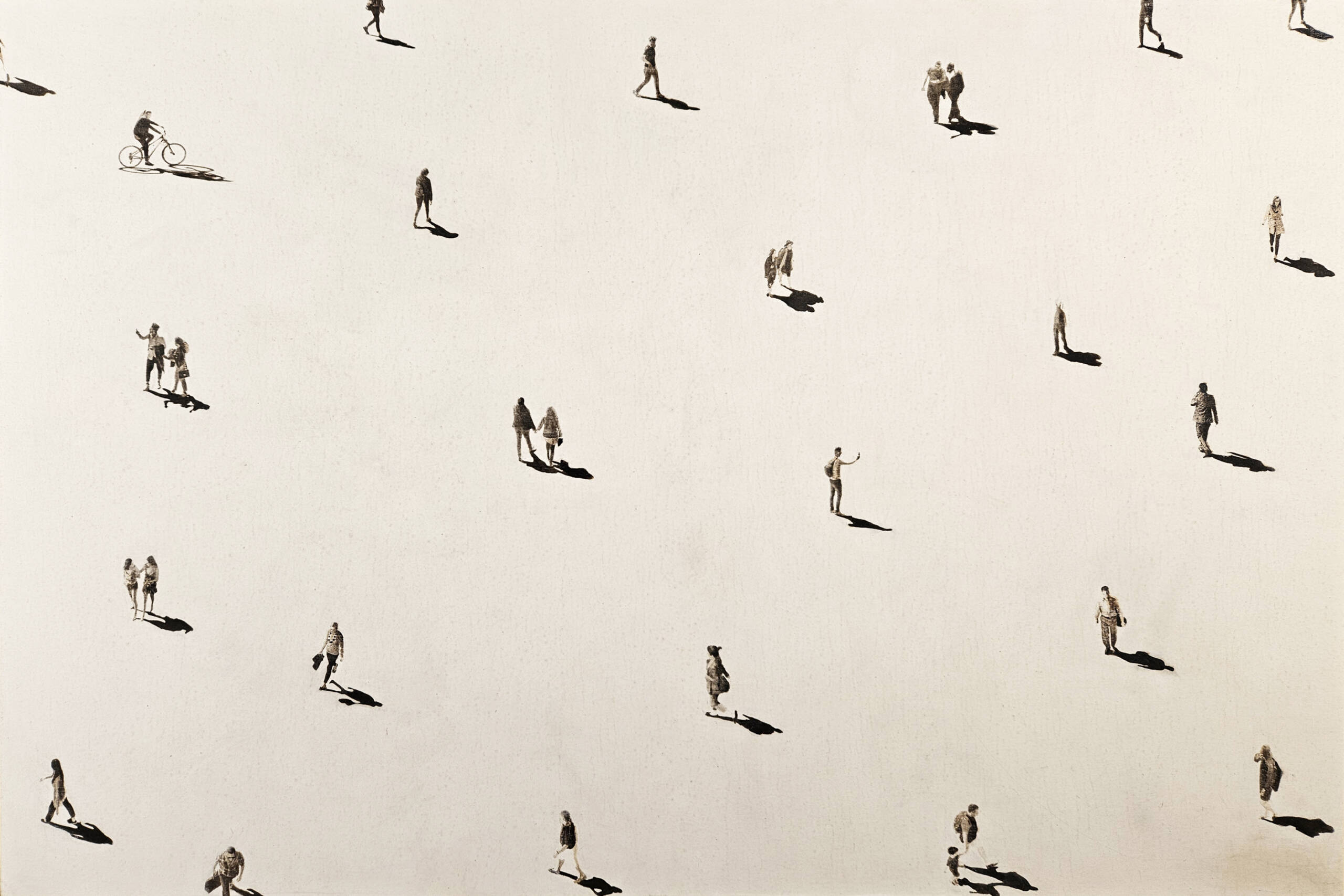
“People” was inspired by a morning visit to the top of the Leaning Tower. From that experience, Lucchesi created a work that observes humanity in motion with eyes suspended between the present and memory. Fleeting silhouettes move across the green square, tracing light trajectories between the paths and shadows of the monuments.
“People is a tribute to Piazza del Duomo, but also to my personal history,” said Lucchesi. “I grew up between the Lupa lawn and the shadows of the Tower. My family has worked there for three generations. This work is a return, a visual embrace of a place that I carry within me.”
‘Operae’ was also already on display in the museum.
Opposite the video, the sculpture ‘Operae’, created in 2024 for the 850th anniversary of the Tower, seems to complete the story. It is a tower composed of 850 thin sheets of marble, with a small man sitting on top. That man, motionless and absorbed, seems to be the gaze from which everything begins. His shadow is reflected on the ground as a trace of the passing of time, a fragile sign of the human being in front of the stone.
The two works, created using different techniques and over different periods of time, complement each other. ‘People’ is not an extension, but an evolution of ‘Operae’: from the silent verticality of sculpture to the ephemeral mobility of shadows, Lucchesi constructs a single narrative made up of presence, passage and reflection.
The video was made with aerial footage by Fabio Muzzi and Giampaolo Antoni, accompanied by the original soundtrack by Rekombinant. Julia Caracciolo, Carlo Alberto Arzelà and Francesca Lucchesi also collaborated on the project.
The works are on display every day from 9:00 a.m. to 8:00 p.m., with free admission. To visit the upper floors of the Sinopie Museum, where the exhibition ‘Behind the Symbols’ is also on display, you must purchase a ticket.
Link to the original article: https://www.quinewspisa.it/pisa-gianni-lucchesi-ombre-e-memoria-in-sinopie.htm
GIANNI LUCCHESI
Gianni Lucchesi was born in Pisa in 1965.
He began his artistic career in 1985 and has participated in numerous important exhibitions and events both nationally and internationally, such as the Berlin Art Fair and the Casablanca Contemporary Art Biennale in Morocco.
In 2006, he received the Cisdac International Prize for Contemporary Art in Rome. In 2012, he exhibited at the first international biennial of contemporary art in Casablanca. In 2016, he began collaborating with Vittorio Sgarbi, exhibiting works at the Museum of Madness in Palermo, in 2017 in Salò, in 2018 in Naples and in 2019 in Lucca. In 2018 and 2019, he worked for the Teatro del Silenzio in Lajatico, collaborating with artistic director Alberto Bartalini and curator Carlo Alberto Arzelà.
He has won numerous contemporary art competitions and created important public works, such as:
the monument to Sandro Pertini in Savona, the sculpture Omaggio alla scrittura (Homage to Writing) in Parco dei Tabucchi (Vecchiano-Pisa) and the installation Operae, first displayed at the Fuori Salone in Milan in 2023 and later in Piazza De Ferrari in Genoa with Rossetti Arte Contemporanea.
Lucchesi’s work has always been driven by the attempt to visually translate the reflections arising from the investigation of the psyche, of the emotional states of the individual in relation to himself, to others and to his surroundings. Through visual metaphors drawn from universal languages that arise from artistic and spiritual research, emotions take shape and colour.
One of his reference codes is the earth understood as subsoil, as a metaphor for the emotional stratification of the subjects observed: earth as an inner environment and roots as the essence of the subject.
A thread, whether in graphic design or painting, is a boundary between the self and the outside world, with everything it contains free to infect and connect on different levels, as happens in the “Interior Environments” in which the thread marks the passage. The places in which his works come to life are chosen with care.
Places with evocative depth and charm, whether created by nature or by human hands, as long as they have the evocative power to encompass new art, a new interpretation of human feeling.

