


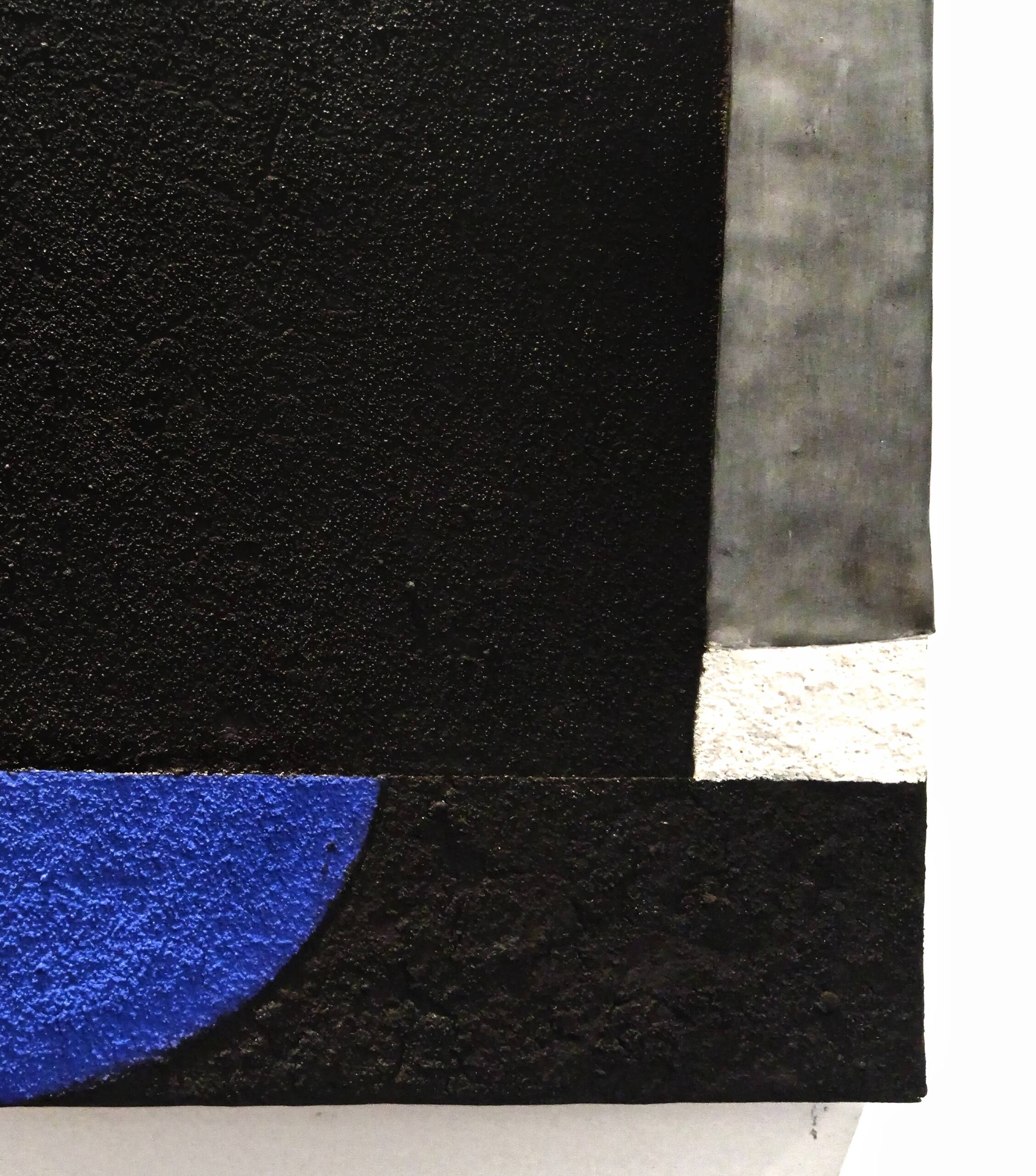
Critical text by Annalisa Ramos – bipersonal exhibition by Gianni Lucchesi and Lorenzo Cecilioni
The artistic encounter between Gianni Lucchesi and Lorenzo Cecilioni triggers the magic of transformation, both physical and intellectual: a dialogue in which the essentiality of the structure does not deny the aesthetics of the form, giving rise to a kind of compositional brutalism, understood in its conceptual manifestation as a clear exposition of the structure and enhancement of the materials, which show themselves in the truth in their nature, without superstructures and compromises.
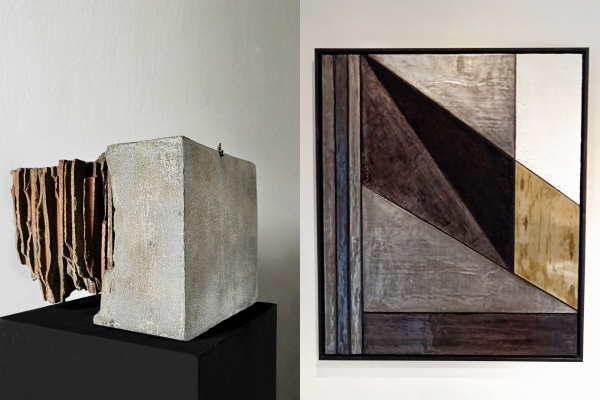
Gianni Lucchiesi’s assumption takes shape from a conceptual basis and follows a project line, developing human kind’s existential reflection of the self. His sculptures are born with an old-fashioned way, the traditional use of the pen for preparatory sketches, and end concretely when the dense lines on paper are transformed into real compositions of matter.
Every element chosen to materialise the concept of his works is imbued and rooted in meaning. In their selection is enshrined a philosophy linked to the process used to obtain a certain type of material, whether laboriously worked by people or excavated by them from the mother earth, inside the quarries, to then be transformed and worked again. Lucchesi has therefore always been interested in the use of exposed reinforced concrete, but also iron, lead, marble and stone: he then assembles and relates volumes with a narrative mode that tends to subtract rather than add, to reduce and essentialise.
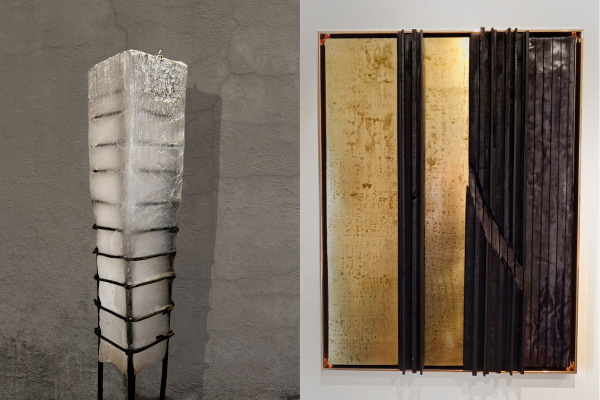
Lorenzo Cecilioni basically works with raw material in a spontaneous manner. Conceived in open form, the work is constructed in the coexistence of the artist’s idea with the material. Lead predominates, but also brass, copper and burnt, rough, lightless wood. Deliberately, Cecilioni combines relationships between materials that are difficult, if not impossible, to control: fire and wood, metal and salt, the reactions that occur when these elements come into contact with each other lead to unpredictable results. The artist’s emotions are conveyed through the material and the creative act culminates in the moment when the balance of the work achieves an ideal conceptual location. Cecilioni’s work is based on a direct and sincere relationship with materials, through which he expresses his compositional sensitivity, which unfolds in harmonies of contrasts and unions, spaces and distances, whites and blacks.
Lucchesi starts from the concept and creates the connections, Cecilioni guides the elements and places the composition.
The two artists are united by their love of matter, their compositional sensibility and their predilection for essential, raw materials destined for raw expressiveness. Another element, for different reasons, unites them, namely the symbolic aspect of materials and their chemical-symbolic connotation. Both, like alchemists, work to transform matter in order to transform themselves. It is no coincidence that for hermetic culture, Blaise de Vigenère’s famous ‘Treatise on Salt and Fire’ represented the crucial moment of transition from the experimental operational phase to the spiritual one. Alchemy, apart from being a chemical discipline, is a philosophy that uses the elements, including metals, to point out a possible way of spiritual research, an experience of growth and a liberation of the seeker. The decline of this discipline was later caused by the rise of modern science, with calls for rigorous scientific experimentation.
The artistic research on display aims to draw attention to the brutalism of relationships, of relations, of today’s society. The human being can also reveal to be brutal, when showing aspects that are crude, essential, and yet true. And it is precisely the investigation into the concept of reality and fiction that occupies a large space in the two artists’ analysis.
Fiction and reality live of continuous exchanges and the creatives make ample use of them, their work is to mould matter to show it beyond the object it represents in itself, to give shape to an idea and to works that, by creative necessity, take on the appearance of something else.
Famous is the work of Fellini, who, in 1973, for his movie ‘Amarcord’, unable to get a real liner to the shores of the Adriatic, he built himself the Rex, a blatantly fake ship, as well as the sea made out of sheets of nylon: a fake, so fake, that it became more powerful than the real one.
Today we are questioning reality and fiction with regard to something that tends towards the real, and indeed towards hyperrealism.
Artificial intelligence creates images that impress us, but it is a relationship with a fiction that tends towards the real, and that becomes more fake than fake. Contemporary consumer society is interpreted from the concept of the simulacrum and the impossibility of separating reality from fiction. The French philosopher Jean Baudrillard argued that the fate and condition of today’s advanced societies is that any fact tends to degrade as such and become a spectacle or object of consumption, regardless of its veracity or falsity. Information and interpretations, issued and received, are equated as mere simulacra of reality.
The distinction between the veridical and the false vanishes; as in the Platonic cave, there are only images among images, opinions against other opinions, different information, but not ‘The Truth’. Both the city and the virtual world fall under the sign of consumption and spectacle, culture itself is experienced as a spectacular fact and a consumerist process. But Baudrillard also states that the simulacrum is not what conceals the truth because, when it knows it is, it does not deceive, it is what it is.

Deception takes place, instead, when one wants to pass off a simulacrum as a truth.
The intention of this exhibition is therefore to take a step backwards, which can be considered, in truth, as a leap towards the essence, to bring us closer to the fascination of constructing a reality that is true, not invented, nor artificial. The idea of subtraction is developed here from a conceptual and social point of view, also applicable to the way we perceive what we see and experience. What remains, by choosing to remove rather than add, is the bare and brutal backbone of the concept, the essentiality of the real, without frills or deception. A research made with four hands and two minds, aimed at rediscovering the ability to break the surface, sometimes fake, in favour of a less conspicuous but imposing and solid reality, like truth.

Itinerari nell’arte: https://www.itinerarinellarte.it/it/mostre/senza-filtro-12544
TheMeltinPop: https://www.themeltinpop.com/post/senza-filtro-gianni-lucchesi-e-lorenzo-cecilioni

