


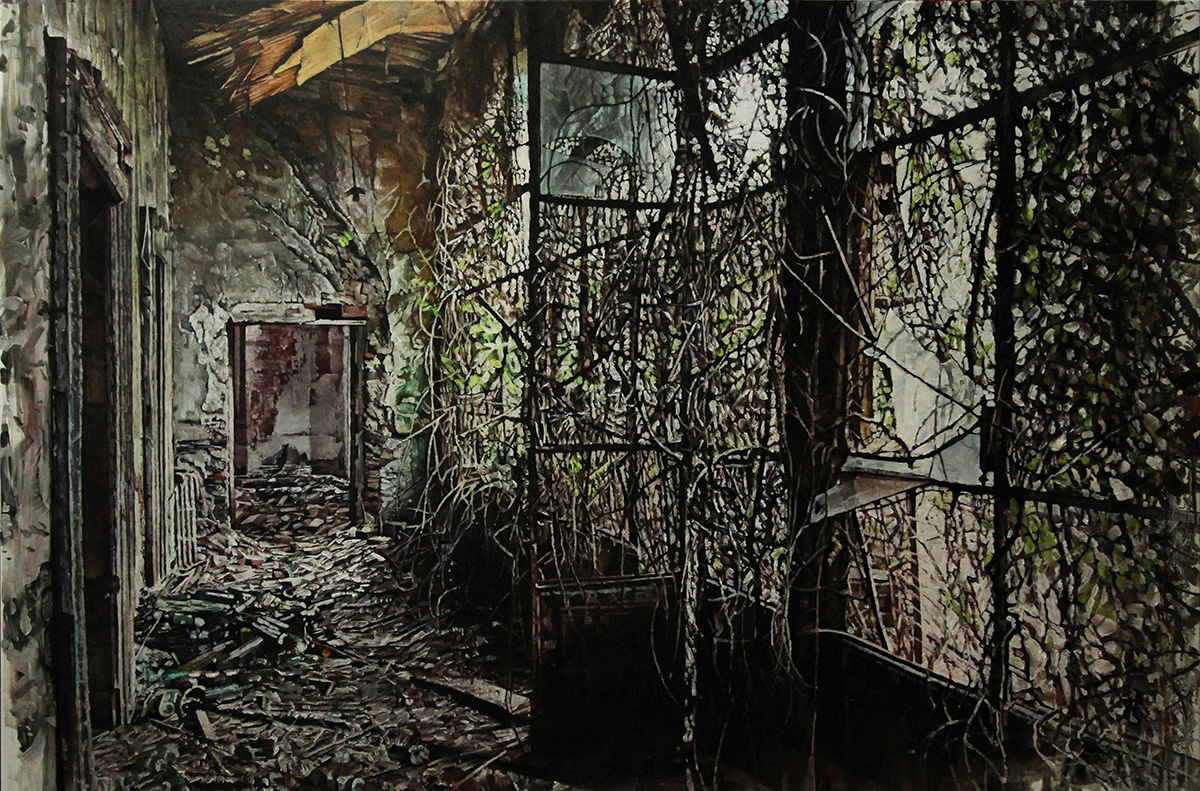
Our collaboration with Andrea Savazzi began many years ago when, while examining the works of the winners of a major national award, our eyes and hearts were totally captivated by his canvases. From the first instant, we sensed that this was an artist capable, with his paintings, of bringing out the silent voice of places and evoking feelings from our memory.
His artistic research is born spontaneously, on the roads of the world, during his travels in the saddle of his beloved Harley: alone, with friends and, above all, with his wife Rossella. The stops on their journeys are conditioned by sightings of their favourite places: dismantled industrial warehouses, abandoned farmsteads, ancient stone fortresses where nature, with overbearance, takes back its space.
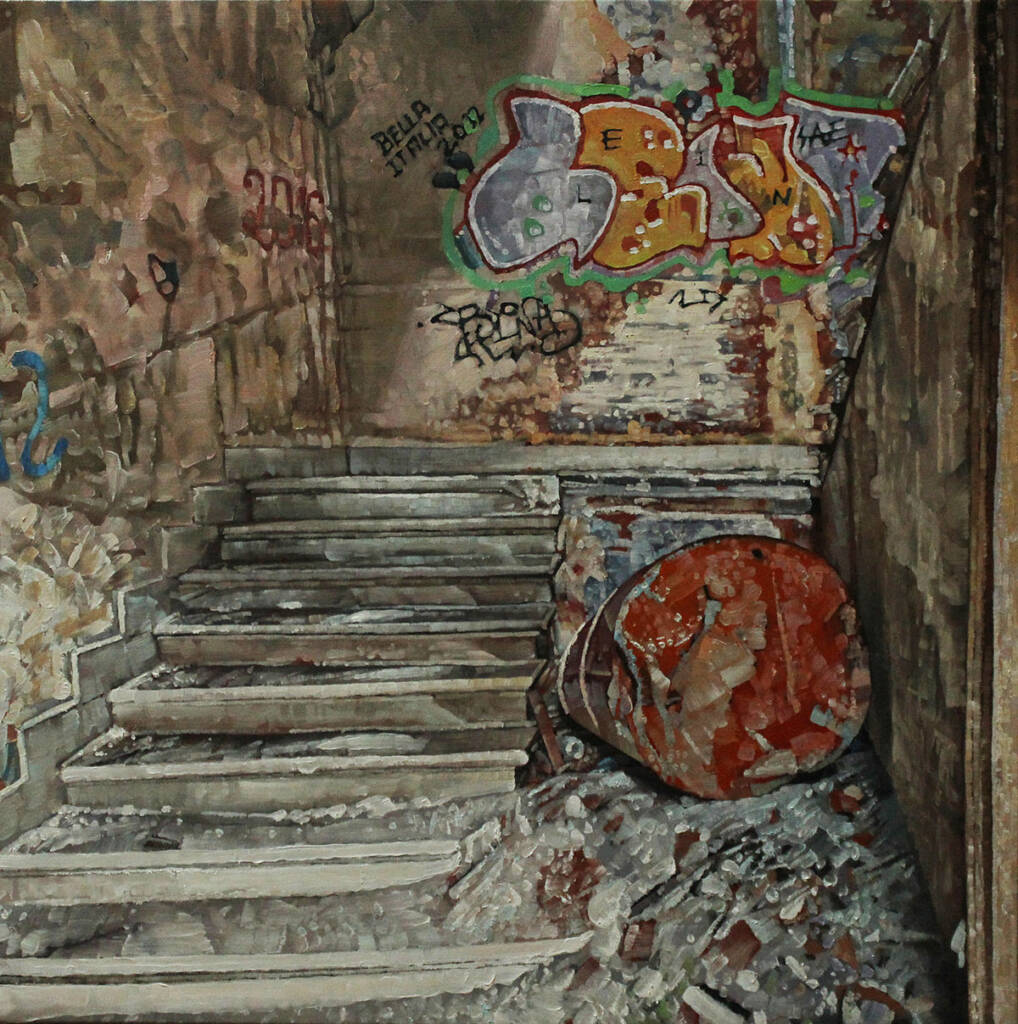
In the field, the photographic phase begins. The main objects of his attention are the uncultivated and overgrown hedges, the stuffed toy abandoned on the floor, the perspective perfection of the stairways ruined by time. Back home, locked in his studio and surrounded only by the silence of the Cremonese plains, Savazzi begins the story of the piece of the world he has seen, with his favourite medium: the paintbrush.
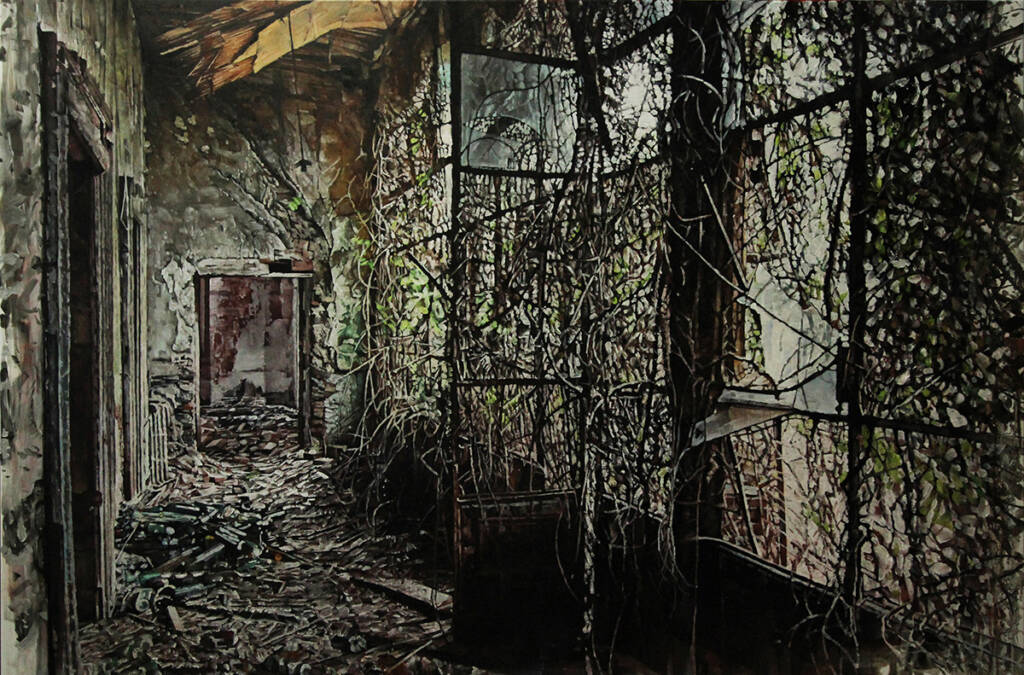
What his painting evokes in us is entirely subjective.
What certainly happens to all of them is that their gaze gets lost in the intricacies of the debris and brushstrokes, calling to mind images and sensations. Some see the family farmhouse again, others, a place they frequented secretly during their childhood.
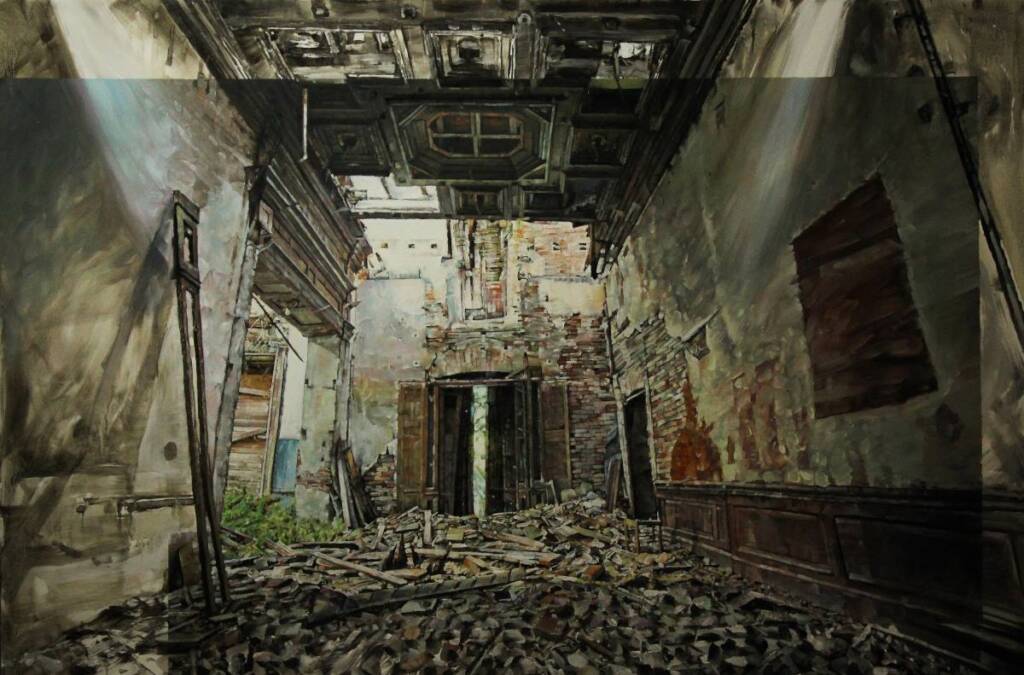
A few months ago, a passer-by stood for several minutes in front of our shop window, on which the work “IN#39 – The Weight of Time” was displayed, before he managed to look away. He claimed that the composition reminded him of the famous photograph taken in London just after the 1940 Blitz bombings, which shows three men searching for books in the rubble of Holland House Library.
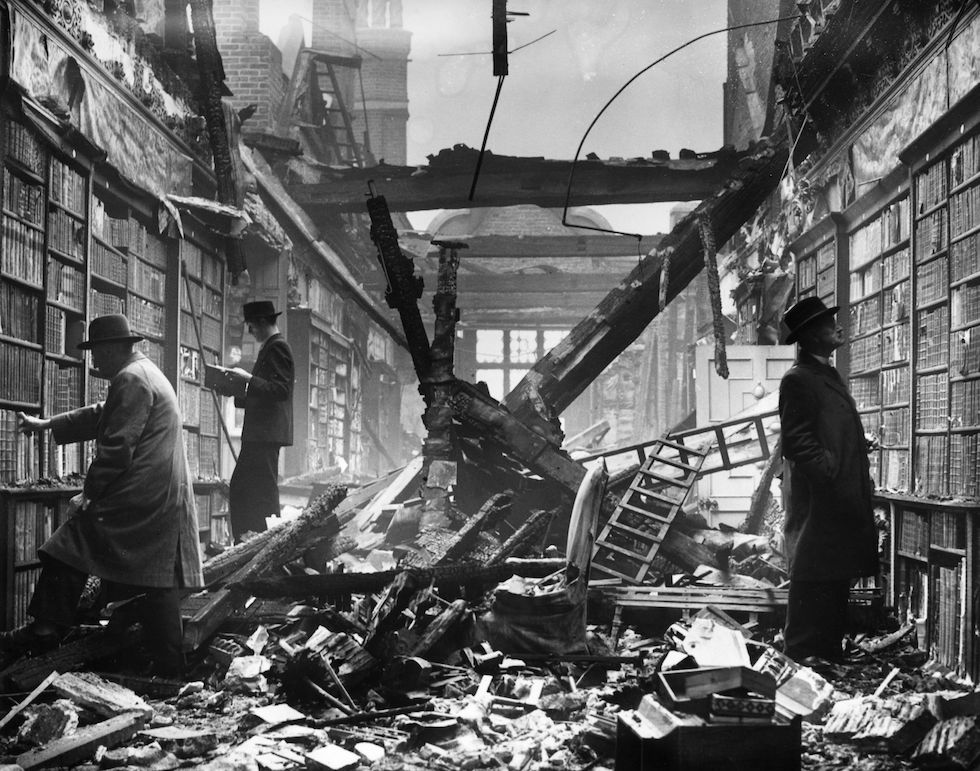
The iconic photograph was made for propaganda purposes and is today an emblem of resilience: despite the chaos of their surroundings, people remain focused on their quest, focused on knowledge, regardless of what is happening around them.
The juxtaposition between the historical photograph and the painting is plausible not only because of the composition of the lines in the painting, which are quite casually similar to the photograph, but also because of the feeling of beauty and hope that can be discerned in the brutality of the chaos.
EMPTINESS, BEAUTY, SILENCE
This is precisely what we perceive coming out of Andrea Savazzi’s works: decay is filled with moving beauty, silence envelops, with care and gentleness. Emptiness fills with ancient stories, probably not even our own, but not too far removed from everyday reality. This silence, the elegance of the void, reminds us how, no matter how inhospitable our surroundings may be, what counts and makes the difference is the essence, the memory and the depth of being.
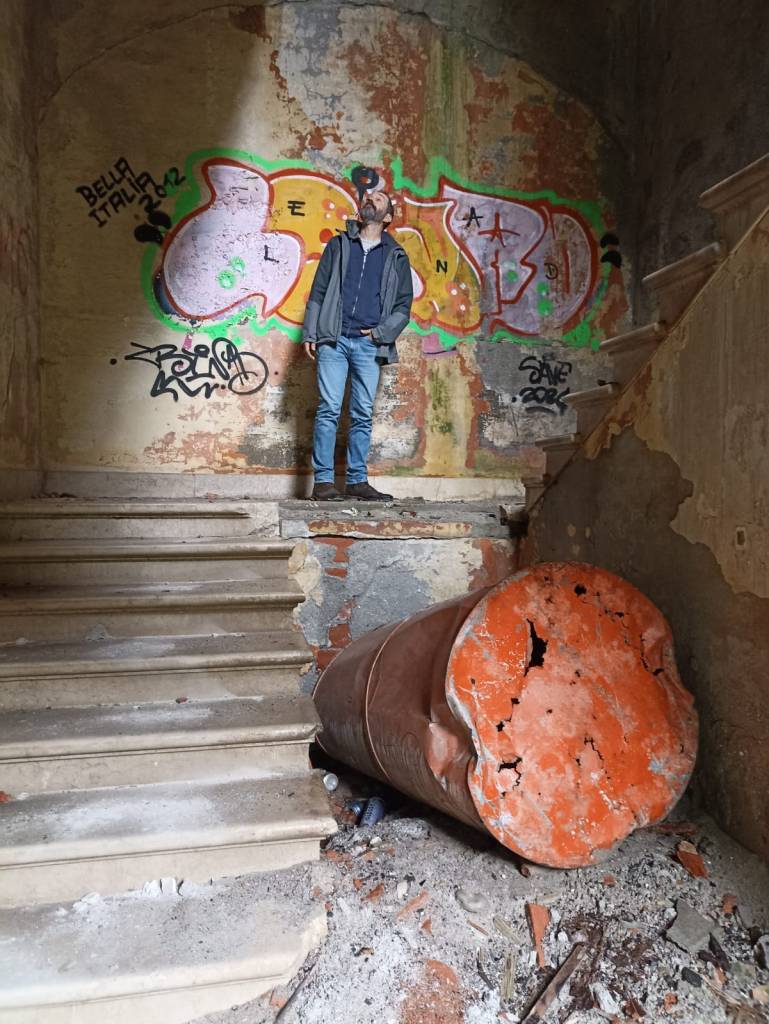
The artist’s latest works, which have recently arrived at our gallery, present an unprecedented detail, namely the evident representation of a deliberately monochrome area of the painting, left unfinished. This is the effect of an innovative experimentation, aimed at producing an accentuated perception of abandonment and decay. This is a new, momentary artistic phase, which, according to the artist, may remain, evolve or disappear in future paintings.
andrea savazzi
Andrea Savazzi was born in Casalmaggiore in 1974.
Over the years, he has developed an innovative painting style; his is a continuous research rooted in the study of painting techniques of the past.
“Andrea Savazzi’s way of doing things is the pictorial elaboration of a pre-existing image taken from an old painting, from a photograph, from images of striking facts we have already seen and memorised. He paints them with colours that represent reality, but seem to melt, to unravel, a sort of optical disturbance.
They are representations of the already seen, the already experienced, executed as if it were a slow unravelling of the image.
In his pictorial elaborations, the language is poetic, with, at times, an ironic and grotesque approach.
On the surface, the images appear to be unsharp, it takes an instant, the time to squint and the image changes.
The artist offers us the real, the already seen, he is poetic in describing the industrialised urban suburbs; we perceive their corrosion, pollution, decay.”
(Sauro Poli)

