


Text by Alessandra Redaelli on the occasion of Gianni Lucchesi’s exhibition.
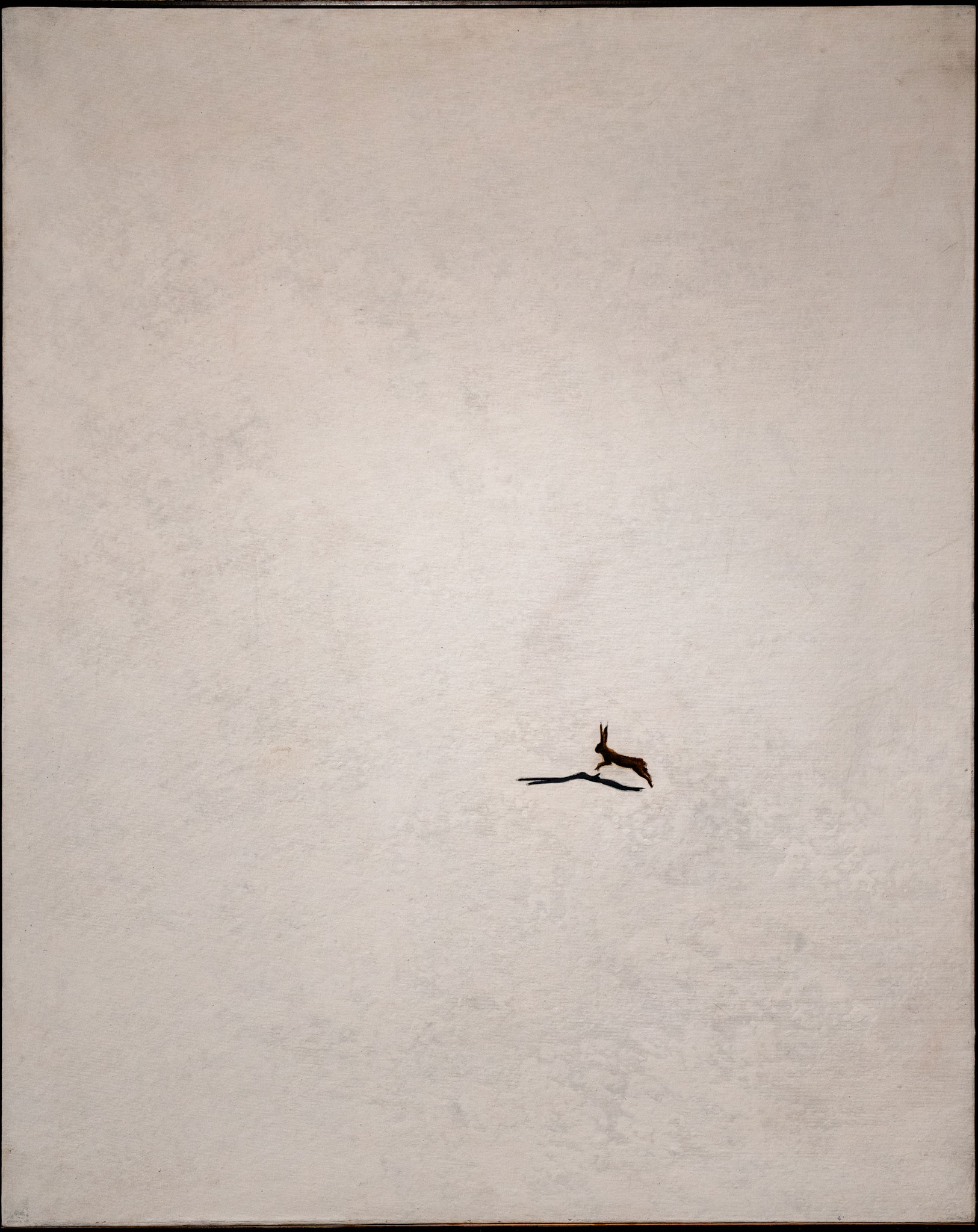
The animal is alone on the white, uneven surface, made rough by a series of small craters. Beyond the horizon, the darkness possesses an inappellable absoluteness. It is a sidereal, primitive darkness. Before the order and even the chaos. Yet in the ears raised to pick up even the slightest noise and in the determined leap, the animal gives the idea that it knows exactly what it is doing, that it has a goal.
Gianni Lucchesi’s new project stems – as his entire output – from an admirable mix of synapses and emotion. His work acts like this: it strikes heart and brain in unison without leaving any escape, as if he has found the perfect formula to give a soul to the conceptual.
A Hare on the Moon is almost an oxymoron.
Like “the chance encounter, on an operating table, between a sewing machine and an umbrella,” to quote Lautréamont. Or it is poetry.
When Lucchesi first listens to The Hare, by singer-songwriter Lucio Corsi, his imagination sparks off in several directions. One is that of enchantment: the fox and the Little Prince. The other is that of scoffing: “Houston, what bad luck!” sings Corsi, “we’re too late, there’s a hare on the moon,” and immediately there in our heads appears the astronaut’s face looking out the porthole, his astonished gaze on the animal that – in the leap – spitefully shows him its backs. And in an instant he realizes that all that precise, organized, rational being, with his computer full of rigorous calculations, has been for nothing.
The hare, with a leap, came first.
Gianni Lucchesi’s investigation has always been about our feeling and our not (wanting) to feel, about looking inside and looking outside. Ever since he was moving in the realm of a lyrical, emotional abstract, where interior enviroments – inner landscapes – took shape through juxtapositions, brushes of matter, contrasts of color that were never random but strongly symbolic, in a path that, if it had to do with an enlightened middle school teacher (who was in the habit of asking her students for abstract compositions to give an emotional interpretation of the texts read in class), was not so far removed from the philosophy of Mark Rothko, who preached and practiced a direct communication of emotional states to the viewer through stripping the work of any detail that might distract it.
His passion for large masses of scrap iron, immense snakes produced in the moment the blast furnace mechanism jams and destined for destruction, also follows that expressive path.
The giant tangles, like apocalyptic monsters, wrapped in coils and flickers, became in his hands searching souls, entities in dialogue, blessed at the ends by a dusting of gold that illuminated their space of possibilities.
It was his fascination with alchemy and all materials capable of transformative power that led him to iron, so powerful in its primordial nature as a meteoritic substance: a gift from heaven and the gods offered to man so that he might work the earth, transform it, make it his own, and in the meantime transform himself, improve and grow. Of course gold, too, then, ending up falling in love with -and making his cipher- the contrast between light and shadow, smooth and rough. And always, over everything, that ability to give to the formless the form of emotion, the one that goes deep into the stomach and makes us look at iron snakes with our hearts jolting for a moment, long before we understand why, long before we read titles, captions, explanations.
Then something happens in Gianni Lucchesi’s life.
One of those terrible and illuminating events that turns perspectives upside down. A fire destroys part of his works, many objects dear to him. But emptiness, you know, is made to fill. And suddenly his language shifts: it becomes figurative.
The reversal, however, turns out to be twofold: the process of constructing legible forms for some reason forces him to change glasses, to change readings. Now his narrative no longer looks only to the innerside, but also to the outside.
Relationships with others and with the environment are the theme on which his figures move, small but defined in the detail of dress. And the dress is what people wear to go to a “serious” job, perhaps behind a desk, immersed inside a normality where appropriateness borders on alienation.
Small characters who are man as humanity, just like the Everyman protagonist homonymous of the allegorical novel written in England in the second half of the fifteenth century, where the protagonist has to deal with Death and with characters called Knowledge, Strength or perhaps Good Deeds. A replicant humanity in which resonate echoes not far from the poetics of an artist like Antony Gormley.
He, that Everyman in a suit and tie Lucchesi gives us, narrates his own inner conflicts and dismay of the outside, the other and the beyond.
Perhaps he points a gun at his own doubled image; he seeks peace in claustrophobic rooms; he leans poised over abysses as deep and unfathomable as a repressed trauma; he lightheartedly plays leapfrog with himself -so incongruous and unsettling with that clothes on- on the end of trampolines that will inevitably lead him to annihilation; or he points (again) a gun at the infinite reflections of himself that send him back to the anguished play of mirrored front walls, perhaps the protagonist of a dystopian thriller. Images as crisp, clean and fulminating as a verse by Ungaretti.
There is no judgment or moral lesson, in the artist’s narrative: rather, a photograph of a discomfort, always conducted with an eye to beauty, to the purity of forms, to materials that soar like the megaliths of Stonehenge to welcome our gaze inside warm spaces, on vivid, breathing, at times rough surfaces, cut by a meticulously studied light that breaks through the openings, sharpens the edges, caresses the curves and lengthens the shadows in a kind of eternal Caravaggio-like twilight.
The imminence of disaster -when the shot is about to explode, or our little man is about to lose his balance and be swallowed by the chasm, or, again, when the tango dancers, in the sensual whirl of the dance, are about to be plunged over the edge of that meager dance floor- does not communicate to us anguish but an anticipatory sense of the wait, a kind of perverse expectation.
And herein lies the key.
In the end, what did man do of that meteoritic iron that rained down from the sky to enable him to work the earth? What did he do with his intelligence, his evolution, his technologies? What did he do with Prometheus’ fire?
Lucchesi, we said, does not give lessons or answers. He points. At most, he asks a few questions.
But the questions are the kind that burn.
The dance on the edge of the chasm as well as the game of leapfrog on the edge of the abyss are a tale of humanity lost within itself, too busy observing the world blindfolded to realize where its manner is taking it. The golfer, alone, bends over the ball in the center of a surface annihilated, destroyed, unequivocally traversed by something inemendable, pretending that around him there are a green, manicured lawn, flags, other men dressed in white.
It is a blindness that has the flavor of denial, of removal, even more glaring when one looks at how the deer herd moves, on the same burned surface.
True to an economy of narrative that goes hand in hand with chromatic minimalism, Lucchesi for a long time has chosen a single animal, the deer precisely, to serve as a counterbalance to the human figure. Majestic, elusive, imbued with magical symbologies of rebirth linked to the periodic renewal of the antlers and, precisely by virtue of the antlers, the medium of communication between earth and sky, the deer embodies for the artist the pure and intact instinct. What he knows. While man is lost in his illusion of happiness, clinging to an impossible survival, the animal forms around him the herd and seeks a way of escape.
What man lacks, then, is instinct, the security of an act that cannot involve decision or reasoning.
The wild soul, stifled by rationality disguised as certainty. And it is perhaps for this reason, I venture to surmise, that Gianni Lucchesi’s small figures are almost always men, males, and very rarely women. Women possess within themselves, in their reproductive nature and so deeply tied to the cycles of the body, an instinctual and wild potentiality that is difficult to extinguish completely.
The hare – declined in the feminine (in Italian it is a feminine noun), but of a gender that cannot be defined, since it has no antlers to make its reading unequivocal – comes to complete a linear and very precise path: the unerring instinct is tinged with poetry and becomes here creative imagination, the ability to dream.
If in the large bitumen paintings the artist confronts us with the different dynamics of the groups of humans and deer – the former scattered, isolated, lost in their abstract reasoning, at best grouped in sparse family units, or in pairs, but closed in monads impermeable to each other; the others cohesive, certain in their path – the hare becomes the protagonist of a revolutionary, titanic gesture, a symbol of the miracles that sometimes illuminate reality with another light, suddenly opening up possibilities. It, with a leap, leaps to the moon.
The hare has realized that the planet is imploding, that its happiness no longer dwells there.
So it goes away, elsewhere. It does not think about how to get there, what it leaves behind, how it will feed itself, or even how it will breathe. Its instincts tell to go, and it goes.
A Moon thus becomes the perfect setting for that delightful game that Gianni Lucchesi loves to play with shadows, enhanced by the lights in the sculptures and the skilful use of bitumen in the paintings. Those strange silhouettes, which embody us but never quite are, attestations of existence and consistency (think of poor Peter Pan and how he suffers when he loses his shadow), dark sides, unconscious abysses, instincts, inseparable companions, find their apotheosis on the satellite that shines with other people’s light and that on the shadow has built its myths and poetry.
There, looking out toward this snow-white horizon lost in the blackest blackness, following the danced leaps of a finally happy hare, is he, the man watching from the porthole.
We can imagine him in a suit and tie, like the others, and perhaps, if we investigate his story for once, we discover that he is a young man with many ideas and too much money. Perhaps he thought that, once ruined one planet, one could easily conquer another, just as one throws away an old car. He put a few friends on top of a rocket and went up there, to conquer the Moon; imagining it already, perhaps, with large pressurized structures where he could live, work, go to restaurants and shop. It may be that he has already found a way to dispose of the waste. But there’s still time, he thinks.
Then he sees that light bounce, the vibration of the tail. He almost has the feeling that the animal is turning toward him, before disappearing behind a dune. And suddenly he realizes that no, it can’t be done anymore. You can’t consume it all. Maybe.
Text by Alessandra Redaelli on the occasion of Gianni Lucchesi’s exhibition.
All the works of Gianni Lucchesi:https://www.rossettiartecontemporanea.it/artista/lucchesi-gianni/
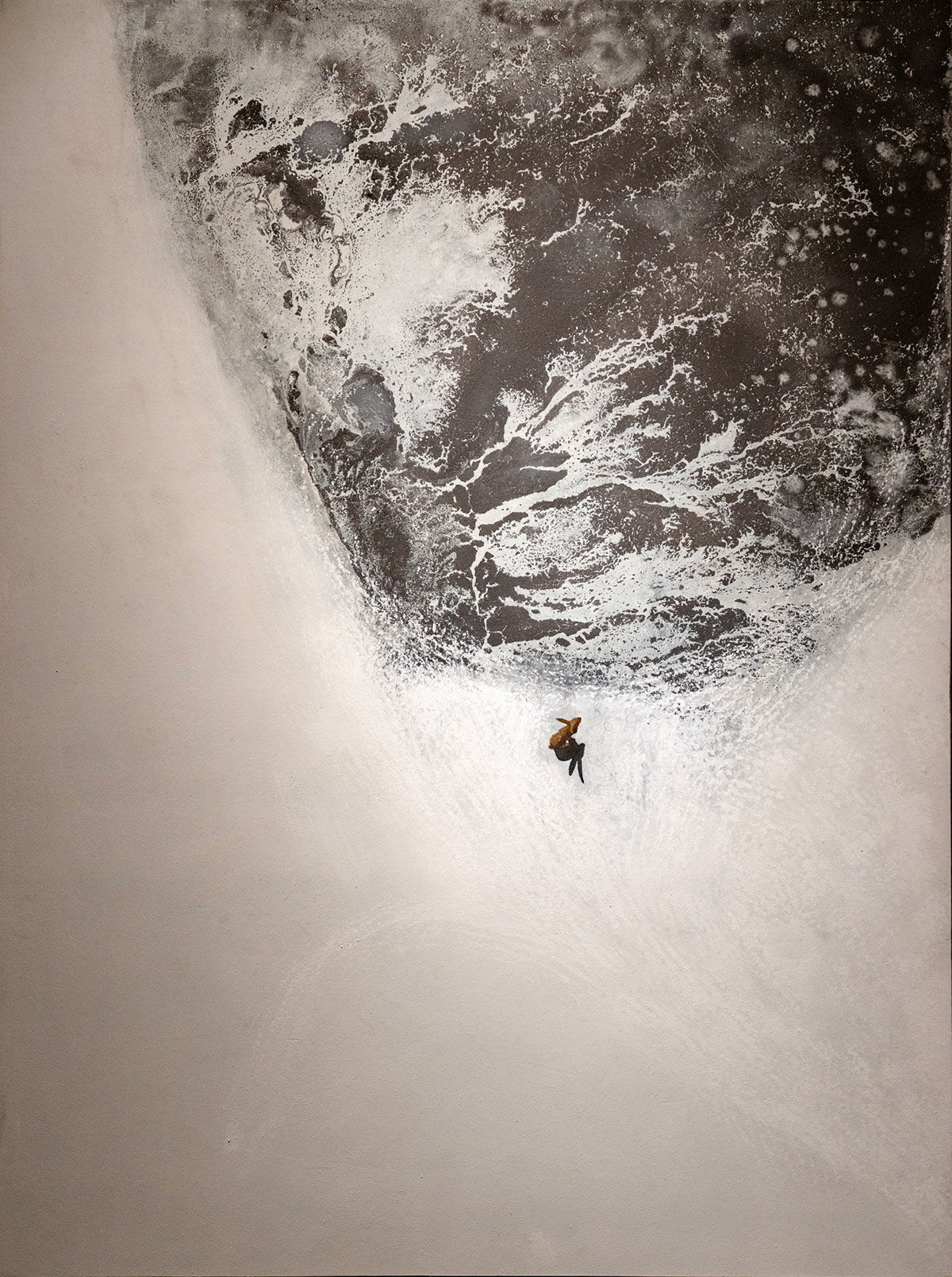
“Houston what bad luck 9” – painting on display at Gianni Lucchesi’s exhibition.
Gianni Lucchesi’s exhibition on Itineraries in Art: https://www.itinerarinellarte.it/it/mostre/gianni-lucchesi-houston-che-sfortuna-6837
Gianni Lucchesi on La Repubblica: https://genova.repubblica.it/cronaca/2023/09/21/news/scultura_piazza_de_ferrari_genova_colonna_gianni_lucchesi-415320289/
The exhibitioon by Gianni Lucchesi on Arte Magazine: https://artemagazine.it/operae-la-scultura-di-gianni-lucchesi-sul-rapporto-uomo-spazi/

